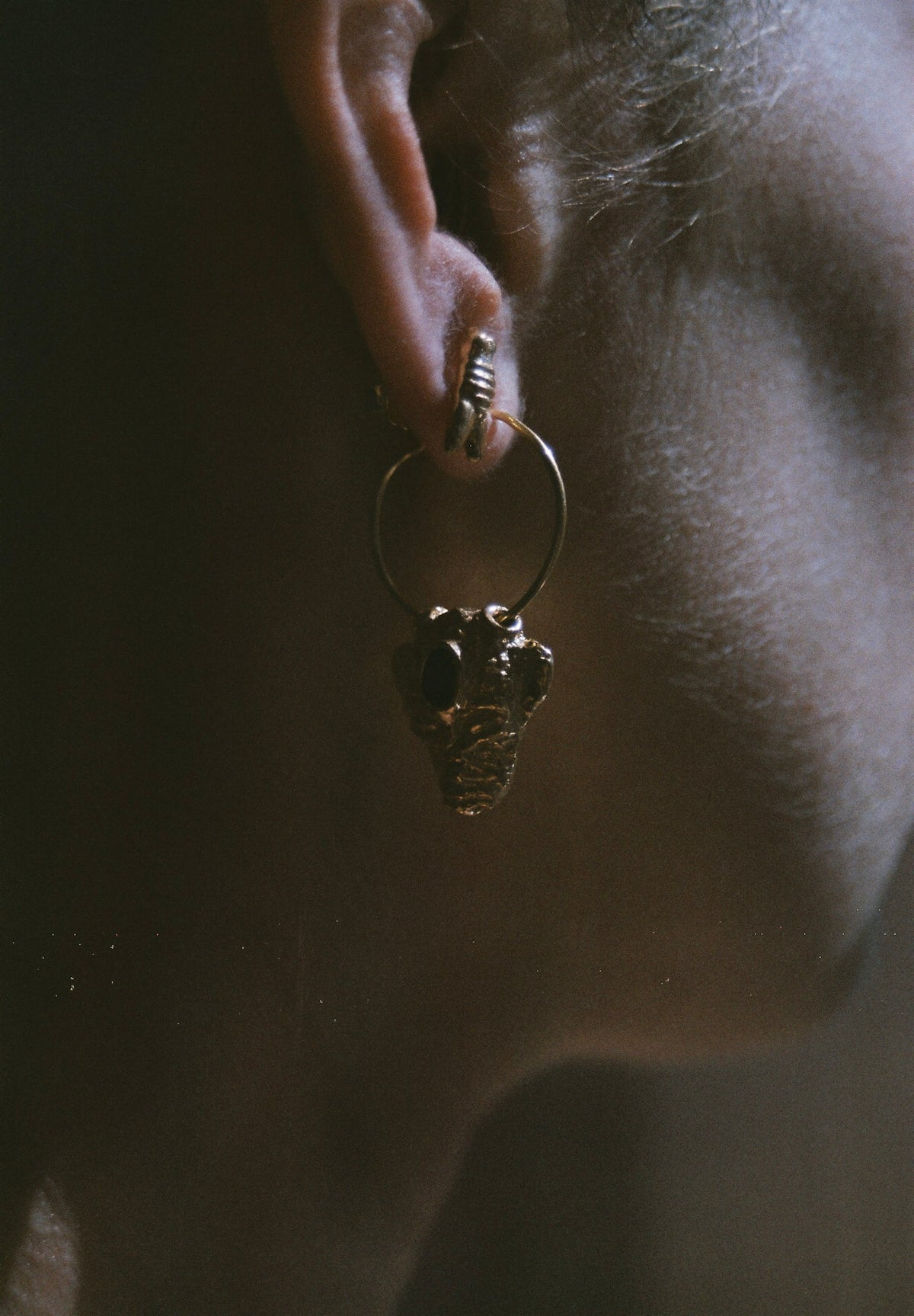
Divine Bull Earrings
Couldn't load pickup availability
Hoop Earrings with Bull Pendant and Natural Garnet
11.6 g | 6.3 g per earring
24k Gold Vermeil | 925 silver
Share

The bull held an exceptional and enduring place in the religious imagery of ancient Cyprus. From the third millennium BC until at least the sixth century BC, it was one of the most frequently invoked manifestations of divinity, appearing throughout the island in a remarkable variety of artistic and ritual forms. Unlike the often violent and powerful bulls depicted elsewhere, the Cypriot bull was generally represented as a placid creature, associated with life and fecundity.
This gold ear-ring, dating to the Late Cypriot period, reflects this wider importance of the bull in Cypriot visual culture. A single circular hoop with overlapping terminals supports a hollow pendant in the shape of a naturalistic bull's head. The pendant was formed from two halves soldered together, with carefully detailed eyes, ears and nostrils. Grooved ridges represent the animal's hair across the brow and nose.
The hoop passes through two holes in the bull's forehead, which are surrounded by protective rings. The pendant is decorated on both sides, suggesting that the bull's head was intended to be fully visible as it was worn.
The ear-ring was excavated in Tomb 84 at Enkomi, a site specifically associated in the chapter with important representations of the bull. Among these is a bronze group showing a bull being led on a four-wheeled cart, as well as the famous “young god”, who wears a helmet adorned with bull's horns.
Bull heads and skulls, or bucrania, appear independently in Cypriot religious imagery, including sanctuary models from Vounous in which they are mounted on structures within a sacred space.
Marshall, F. H. (1911). Catalogue of the Jewellery, Greek, Etruscan, and Roman: In the Departments of Antiquities, British Museum. order of the Trustees.
Rice, M. (2014). The power of the Bull.
Goring, E. S. (1983). Late Cypriot Goldwork (Doctoral dissertation, University of London).